







For decades, Mangino Chevrolet has been a cornerstone of Amsterdam New York. Like any high-performing successful vehicle dealership, its service department’s profitability depends on three critical factors: productive bay uptime, technician efficiency, and service equipment that are engineered to deliver value year after year.
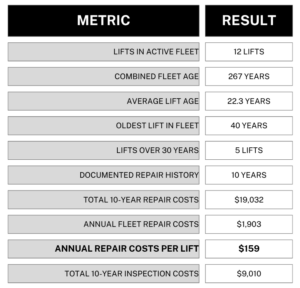
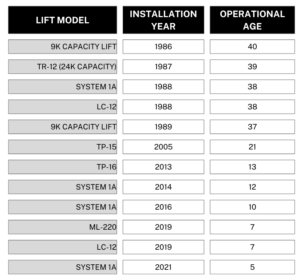
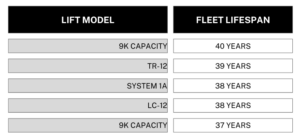
This case study evaluates Mangino Chevrolet’s fleet of Mohawk Lifts through the lens of Total Cost of Ownership (TCO) across a ten-year analysis; January 1st, 2015, through December 31st, 2025. The dealership’s fleet includes twelve Mohawk lifts with a combined service age of 267 years and an average age exceeding 22 years. Most notably, five lifts reached between 37 and 40 years of continuous service- including two 9,000lb capacity lifts that actively remained in operation until 2025 after approximately four decades of service.
Supported by ten years of complete dealership repair records, this analysis pairs real-world maintenance data directly with equipment longevity. The results show a clear advantage of ownership:
- Minimal Maintenance Cost: Ongoing repair expenses remained exceptionally low relative to the fleet’s age and heavy daily workload.
- Extended Equipment Lifecycle: Decades-long service life allowed the dealership to repeatedly defer costly replacement expenditures and avoid shop installation downtime.
- Maximized Return on Investment (ROI): Sustained operational uptime directly protected labor productivity and revenue generation across every service bay.
Ultimately, Mangino Chevrolet’s results tell a compelling ownership story-the core of Mohawk’s value proposition: premium engineering and American-made durability yield the lowest long-term cost of ownership in the industry.
Equipment Longevity: Four Decades of Daily Service
Beyond low maintenance costs, the single most impressive metric in Mangino’s fleet data is the equipment lifespan.
Nearly half of the dealership’s lifts have exceeded 30 years of continuous service. Five individual lifts reached between 37 and 40 years of daily operation, and two 9,000-lb capacity Mohawk lifts remained actively productive until replacement in 2025 – after approximately 40 years of service.
For most standard shop service equipment, a lifespan like this would be virtually unheard of. For a daily-use vehicle lift – a revenue-producing asset operating continuously in a heavy-use dealership service environment, it is incredibly remarkable.
Mangino Chevrolet TCO Snapshot
A Fleet Built Across Four Decades
What Has Maintenance Actually Cost?
Over a documented 10-year tracking period, Mangino Chevrolet recorded 10 years of repair records, showing approximately $19,032 in total repair expenses and $9,010 in annual safety inspection costs across its entire 12-lift fleet.
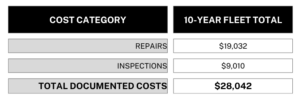
The documented repairs logs were largely limited to routine, serviceable wear components—such as rollers, safety cables, valves, fittings, switches, lift pads, and chains—rather than major structural or system failures. For equipment of this age operating in a heavy-use dealership environment, this distinction is significant: these lifts did not merely remain operational, they continued producing revenue with remarkably minimal corrective maintenance.
When broken out across the entire fleet, the annualized operating expenses demonstrate the true scale of Mohawk’s engineered durability:
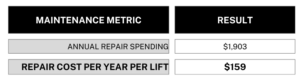
The Value Benchmark: Outperforming Industry Standards
This lift performance outcome far exceeds typical industry expectations. Competitors such as Rotary have published marketing materials* indicating that 20,000 lift cycles represent more than 15 years of service in an average shop. Industry sources set the practical service life of a well-maintained commercial lift at roughly 10 years in professional shop use. Mangino’s fleet of Mohawk lifts have operated for more than double that benchmark – reaching 37 to 40 years of service – without experiencing the escalating maintenance costs or component failures often associated with aging equipment.
While aging lifts usually trigger rising maintenance and repair costs, and eventually forced replacements, Mangino’s Chevrolet’s records show decades-old Mohawk lifts continuing to support daily operations and revenue efforts on minimal, predictable maintenance—compelling evidence of an ultimate financial return on long-term equipment investment.
* https://vsgdover.bynder.com/m/54b7ed2c378f02bc/original/Rotary-SPO20-BROCHURE.pdf
Why Have These Lifts Lasted So Long?
When reviewing a fleet with this kind of longevity, one of the first questions that emerges: How does a vehicle lift remain productive for nearly four decades?
The answer is not that these lifts required zero maintenance; it is that the service dollars needed to keep them running to peak productivity remained exceptionally low.
While routine service is expected in any high-volume dealership, sustaining a 12-lift fleet over several decades at such a modest cost is extraordinary. At an average of only $159 in repair spend per lift per year, Mangino’s expenses represent a very little maintenance expenditure for revenue-producing shop equipment. This real-world performance outcome solidifies Mohawk’s position as the lowest TOC brand in the industry-especially when compared to competing lifts that may require more frequent servicing or earlier replacement.
Engineering Designed to Reduce Ownership Costs
This multi-decade durability is a direct result of intentional engineering choices. Mohawk has long emphasized heavy structural construction, large hydraulic cylinders, mechanical locking systems, repairability, and the reduction of common wear components wherever possible. These choices are designed not only for long service life, but also to limit the frequency and cost of maintenance over that life.
- Heavy-Duty Steel Construction: Columns are built from ¾-inch thick forklift mast steel, delivering unmatched strength and reliabilityover a lifetime of use.
- Mechanical Safety Locks: All position locks engage every 3-inches in both columns – starting at just 4-inches off the ground and continue to full lifting height. Backed by multiple redundant hydraulic safety systems.
- Hydraulic Cylinders: Large 4” cylinders provide longer seal life and lower operating pressure for smooth lifting power with fewer moving wear parts.
- Steel Roller Carriages: Each carriage rolls on eight double-sealed, self-lubricating steel ball bearing rollers.
- Built-in Repairability: Serviceable component layouts that allow routine wear parts to be replaced quickly and affordably.
While no single factor guarantees a specific service life, Mangino Chevrolet’s real-world results demonstrates the power of Mohawk’s engineering. As Mike Coffey, Vice President at Mangino Chevrolet noted, “We’ve found that replacing equipment every ten years is far more expensive than buying durable equipment once. If another dealer asked me how to lower operating costs, I’d tell them to look beyond purchase price. Our Mohawk lifts have delivered decades of dependable service, low maintenance costs, ultimately driving a much lower total cost of ownership.”
Against standard industry models that budget for heavy repairs or life replacement every decade or two, Mohawk’s proven longevity delivers a substantially lower lifetime cost.
The Cost of Replacement That Never Happened
Maintenance invoices are easy to track because they arrive routinely. Replacement costs are less frequent, but they represent the single largest equipment expense a dealership faces.
Most competitive lifts, based on their own marketing data, carry a lifespan of only 8-15 years, requiring regular replacement of critical wear items – such as plastic slide blocks and cables. By comparison, the Mangino fleet includes lifts that achieved:
The Value of Eliminated Replacement Cycles
Using an industry 15-year ownership benchmark, a single lift operating for 40 years eliminated up to two full replacements projects over its operational life.
Across a 12-lift fleet, avoiding these replacement cycles saves far more than just upfront purchase price of new machinery, it directly prevents:
- Unplanned Capital Outlays: Eliminating repeated $10,000+ per-bay capital equipment purchases.
- Costly Bay Downtime: Avoiding shop disruption, tear-out, and installation delays that take productive bays offline and away from producing revenue.
- Lost Service Revenue: Protecting billable labor hours and technician efficiency during peak service times.
When equipment stays productive for 35 to 40 years, the largest hidden expense in shop operations—premature equipment replacement—simply disappears from the balance sheet.
Why It Matters: Productivity & Profitability
Vehicle lifts are not mere overhead expenses-they are primary revenue-producing assets.
A lift generates direct profit every time a technician uses it completes their repair work. The longer that asset remains productive and in service, the greater the return on the dealership’s original investment.
The Mangino Chevrolet dataset highlights two important drivers of Total Cost of Ownership:
- Predictable Operating Costs: Repair and maintenance costs remained exceptionally low despite a heavy daily workload and an aging fleet.
- Eliminated Capital Waste: Multi-decade service life repeatedly eliminated expensive replacement projects, installation costs and lost bay revenue.
Conclusion
When reviewing the Mangino Chevrolet’s dataset, the single most important takeaway is not only the age of the fleet or low maintenance costs considered independently – it is the direct relationship between the two.
Across ten years of documented service records, Mangino Chevrolet maintained a 12-lift fleet with an average lift age exceeding 22 years, including multiple lifts actively producing revenue for nearly four decades. Maintenance expenses remained relatively light while these lifts continued generating value long after traditional ownership models would have mandated replacement.
The result, an undeniable Total Cost of Ownership advantage.
A long service life drastically lowers the annualized cost of the original equipment investment, while controlled maintenance keeps ongoing operating expenses low. Together, these two factors eliminate the need for major capital expenditures, while maximizing the productive, revenue-generating assets.
Ultimately, Mangino Chevrolet’s experience proves a fundamental truth in dealership management: the lowest-cost lift over its lifetime is rarely the lift with the lowest upfront purchase price. It is the lift engineered to be easily serviced, affordably maintained, and kept productive for decades.
In an industry where uptime is everything, Mohawk’s American-made durability, heavy structural engineering, and long-term serviceability deliver the lowest true cost of ownership – guaranteeing value that lasts long after the initial investment -creating significant long-term value for the dealership and an investment that had paid for itself.