








Reprinted with permission of Fleet Equipment, February 1995
It should come as no surprise to read that your job is becoming more and more complicated. Vehicle models and types are proliferating. Operational requirements are changing. Component technology is growing in sophistication. Occupational Safety and Health Administration (OSHA) rules combine with federal, state and local environmental regulations to generate concerns.
It’s in this environment that continuing competitive pressures require renewed efforts to increase shop productivity and cut costs. This includes the selection of the right shop tools and equipment – in particular, the size and type vehicle lifts. The right one can improve productivity and reduce costs. The wrong one can hinder even the best mechanics on their repair jobs and take up an excessive amount of valuable space.
Indeed, when building a new shop, you may even decide that a service pit might be suitable for your maintenance facility. Except for transit bus industry, however, the trend is away from the use of pits due to high initial cost, local zoning restrictions and OSHA regulations. In addition, technicians cannot work on tires while a vehicle is over a pit.
On the other hand, some fleets still opt for pits in new or remodeled facilities. Miami-based Ryder Commercial Leasing and Services is one. While they do install lifts in many of the new facilities, pits are built more often than not. The company offers two reasons:
- With the variety of different sizes of vehicles in its fleet, a service pit is often more suitable than a lift.
- Within reason, Ryder provides its technicians with the type of facilities they request. Company surveys indicate that technicians have a preference for service pits. Lift manufacturers suggest that this preference is a result of heavy-duty technicians being unaware of the benefits offered by lifts since there are not nearly as many heavy-duty lifts in service as there are light-duty designs.
Mike Mele, of San Diego-based Mele Amantes Architects, estimates the cost of constructing a typical concrete service pit, 60 ft. long with a concrete stair at one end, 4 ft. deep, with a 4 ft. wide opening to be approximately $62,231.
ROI on lifts
Steve Perlstein, sales manager at Mohawk Resources Ltd., offers a return-on-investment (ROI) analysis done for the Department of Defense to anyone who doubts the value of lifts. The analysis compares a two-post lift to hand-operated jacks and jack stands for light-duty applications.
Using the latter, a mechanic needs 40 minutes to setup, lift and secure a vehicle before he can start repairs. He can do the same job in only four minutes with a twin-post lift. Perlstein points out that a similar time savings would occur by using a four-post, 25,000-lb.-capacity lift for a heavy-duty vehicle.
Cost estimates based upon current market conditions for different types of lifting systems are outlined below. These costs are greatly influenced by government regulation and local soil conditions.
INSTALLATION COSTS
Type of lift — Lift Capacity — Lift Cost — Installation Cost
In-Ground Two-Post — 43,000 lbs. — $15,000 — $15,000
Above-Ground Two-Post — 25,000 lbs. — $9,000 — $1,000
Above-Ground Four-Post — 50,000 lbs. — $35,000 — $5,000
Mobile Column — 50,000 lbs. — $25,000 — none
Parallelogram — 50,000 lbs. — $45,000 — $5,000
These costs can be greatly influenced by government regulation and local soil conditions.
Lift designs
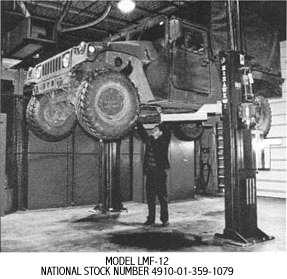
The three major players in the heavy-truck lift field are Mohawk Resources Ltd. of Amsterdam, NY; Advantage Lift Systems based in San Diego, CA; and Rotary Lift, Madison, IN. Mohawk offers above-ground, two-post, four-post and no-post scissor lifts. Advantage markets above-ground parallelogram and in-ground non-hydraulic designs. Rotary has both above-ground and in-ground designs.
All types have advantages as well as disadvantages.
Four-Post Above-Ground Lifts
Advantages: These are easy to load and can be used for both PM’s and service. Portable designs generally have little side obstructions. Platform lifts can service all vehicles. Adjustable runways can lift forklifts with narrow tire width. Rolling jacks provide “wheel freeing” capability for tire and brake service.
Disadvantages: Somewhat wide. Corner posts can get in the way. Tire work is sometimes hard to do. Cross beams can inhibit front-end work.
Parallelogram Above-Ground Lifts
Advantages: These can accommodate most fleet vehicles. They can be portable and have no outside posts to hinder tire work. Relatively small space requirement, they can be flush mounted and have lights in the platform.
Disadvantages: The platform can get in a technician’s way and some designs have a continuous base that can be a trip hazard or inhibit some work. They need additional space fore and aft due to movement of the superstructure when raising and lowering the lift.
Mobile Column Above-Ground Lifts
Advantages: These offer multiple lift application. They’re portable and generally good for repairs that would tie up bays. The use of jack stands allows one lifting unit to be used in multiple bays both indoor and outdoor.
Disadvantages: They’re relatively slow to set up, many moving parts and leave electric cables on the floor. Tire work can be difficult.
In-Ground Lifts
Advantages: These require minimum floor space and offer a clear floor when the lift is not in use. Wheels are free as soon as the vehicle is lifted. There are no posts or legs to inhibit side access.
Disadvantages: Poor for steam cleaning and offer no lights. They are often slow to set up and may not lift all vehicles. Pistons get in the way of work for some jobs.
Mohawk’s Perlstein says fleets generally favor four-post lifts because they’re based on known technology, offer good under-vehicle access, and allow entry from the front or side. His company offers scissor lifts for those fleets that do not have the shop space – about 12 to 14 feet for a four-post lift – or that want to flush mount the lift in a shop. Another alternative in these cases is the two-post, side-by-side frame contact lift.
Selection factors
There is no single lift design that will fill all needs. Here are some factors to be considered:
- Type of vehicles to be lifted and the amount of time it will be used.
- Initial cost.
- Is the facility, owned or leased? Does it require layout changes? What are the soil and water conditions?
- Space available in the facility for the lift, including ceiling limitations, and the amount of work area that will be fully or partially restricted. Vehicle turning radius in and out of the building could be a factor.
- Maintenance and repair of lift.
- Noise levels produced.
- Warranty.
- Service availability.
- Will work be performed outside?
All major lift suppliers have developed programs, including computer-aided designs, to assist fleet managers in making the correct selection.
Tom Phillips, vice-president of Marketing at Rotary Lift, suggests that the consideration of the personal preferences of owners, managers and technicians be added to the list above.
Replacing an in-ground lift
While there are no accurate production statistics for the industry, it is estimated that there are 2,000 or more heavy-duty lifts sold each year. Clayton N. Carley, chairman of Advantage, says that in the heavy-duty truck fleet maintenance market the mix on new purchases between in-ground and above-ground lifts currently is about 50/50. In light-duty applications, up to 8,000 lbs., the ratio is about 85 percent above-ground and 15 percent in-ground.
However, for the previous two decades in-ground lifts were the designs of choice. Because of their age, many now are in questionable condition, which brings up the decision for replacement.
Rotary Lift’s Phillips says among the benefits of replacing a malfunctioning in-ground lift with a new one include the facts that extensive digging should not be required, that electrical and/or air supply lines are already available in the bay area and can be reused and they normally offer desirable service warranties – some as long as 15 years.
On the other hand, if the decision is to go to an above-ground model, the hole must be filled with clean soil and concrete repoured over the area with a minimum thickness of six inches, using 3500 psi concrete.
The benefits of going to an above-ground lift include the facts that installation can be completed typically in less than a day once the concrete has cured; surface lifts can be relocated relatively easily and a 230-volt phase power supply is all that is needed in each bay area.
Non-hydraulic in-ground
Advantage Lift’s Carley says his firm has developed a solution to the problems of oil leakage associated with in-ground lifts. Although at present there are only prototypes undergoing life-cycle tests, plans call for market availability this spring.
The new lift’s electromechanical design requires no hydraulic fluid, thereby eliminating environmental risks caused by fluid leakage. The system is suspended from the shop floor and does not require a foundation under its lifting mechanism. Since the entire lift mechanism can be removed, repairs or relocation require no jack hammer, concrete work or extensive downtime.
TEN SAFETY TIPS
- Operating controls are designed to close when released. Do not block or override them.
- Never overload a lift. The manufacturer’s rated capacity is shown on the nameplate affixed to lift.
- Positioning of vehicle and operation of lift should be done only by trained personnel.
- Never raise a vehicle with anyone in it.
- Keep the lift area free of obstructions, grease/oil and other debris.
- Before driving a vehicle over a lift, position its arms and supports to provide an unobstructed clearance.
- Load the vehicle on a lift carefully. Position lifts supports to contact at recommended lifting points. Raise the lift until supports contact the vehicle. Check supports for secure contact. Raise the lift to desired working height. CAUTION: If work will be done under the vehicle, the lift should be raised high enough for its locking device to be engaged.
- Note that with some vehicles, the removal or installation of components may cause a critical shift in the center of gravity and result in instability. Refer to the lift manufacturer’s recommendation.
- Before lowering a lift, be sure tool trays, stands etc. are removed from under the vehicle. Release any locking devices before attempting to lower lift.
- Before removing a vehicle from the lift area, position arms and supports to provide unobstructed exit.
 LIFT COST JUSTIFICATION