




The Right Lift: How lifts contribute to shop productivity

Click to download the original article as PDF

By Steve Perlstein

The type of lift chosen for a shop can dramatically impact the facility’s productivity level. For example, of the different types of mobile lifts, the faster raising and lowering hydraulic lifts—as opposed to the slower operating electromechanical lifts—can add 54 man-hours of productive repair time per year to your facility based on the one minute up/one minute down cycle time vs lifts that take three minutes up and three minutes down (54 hours assumes you raise four vehicles per day). If this is extended over five years, that’s an extra 270 hours of productive repair time.

While the previous example is specific to mobile lifts, the most common lift type is the above ground two-post frame engaging lift for light vehicles and mid-size trucks. Each time the lift is raised, the shop technicians must bend down and properly position the four individual swing arms and the sliders at the proper lifting points of the vehicle. But, what if you didn’t have to position the swing arms?

Some lift companies offer a lifting pad instead of four swing arms, since the pads speed up certain routine maintenance jobs, such as oil changes. However, these pads are also limited, as they get in the tech’s way on services. Yet, there is a solution.

LIFT DIVERSITY

The Mohawk Speedlane, unlike pad-type two-post lifts, gives shops the versatility of using the lift as a normal swing arm lift or a drive on pad lift for tire or brake service. Like a pad-type two-post lift, the Speedlane can improve turnaround time without limiting what services can be performed.

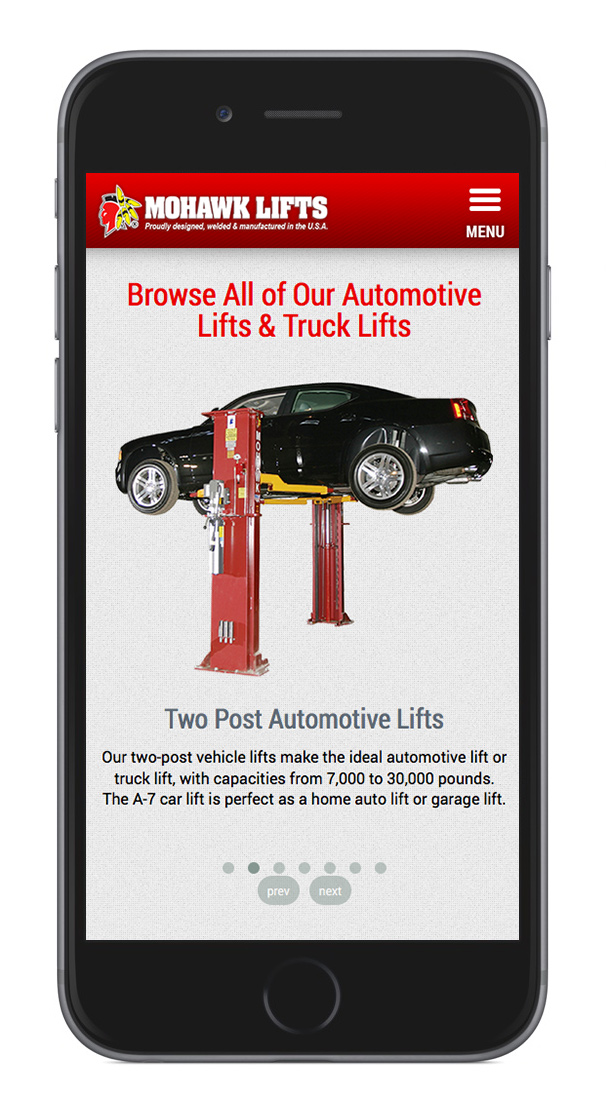
Two Post Automotive Lifts
Two-post lifts are the most common lift type, servicing small and mid-size vehicles.

Doing exhaust work and want the exhaust system to “hang” at ride level? Of course, yet a swing arm lift doesn’t allow this due to the hanging suspension. Tire engaging wheel adaptors can be added to the ends of the swing arms to speed arm placement and raise vehicles faster.

Two-post lifts are the most common lift type, servicing small and mid-size vehicles. Yet, as municipalities and landscaping fleets need to also service turf maintenance equipment, some two-post lifts have the versatility to service light vehicles, trucks, and turf equipment. Ask the manufacturer what lift options and accessories are available to assist in servicing different types of vehicles and equipment.

Mobile lifts offer the versatility of not having to dedicate a bay to a fixed position lift. When using high reach jack stands, the columns can be moved to another bay with the first vehicle remaining in the air for service. The disadvantages of mobile lifts is the few minute setup time to position columns at each tire, yet they offer the flexibility to service light vehicles, raise vehicles front to rear or, used in pairs, to service forklifts.

Having the lift manufacturer do a site survey in advance of purchasing can help to determine where the lifts should be located based on traffic flow and proximity to tool storage. The survey also ensures there is adequate concrete to safely bolt down the specific lift model, proper electricity for operation, and sufficient ceiling height to fully lift all vehicles.

Request a site survey to avoid a four-post lift with 30-ft tracks being delivered when there is only room for 25 ft. Upon completion of the site survey, one should be confident that the type of lift they have decided on will successfully work in his or her shop.

LIFT COST JUSTIFICATION

Mobile Column Vehicle Lifts
Have the lift manufacturer do a site survey in advance of purchasing to help determine where the lift should be located and ensure there is adequate concrete to safely bolt down the specific lift model.

To justify a lift purchase, the 94th Army Command needed to purchase lifts for 10 of their facilities in the northeast. The person in charge compared the time savings between using floor jacks, jack stands, and creepers vs two-post lifts. The determination was that based upon the number of vehicles being serviced, the lift purchase equated to a $140,000 cost saving in just the first year. There was a 40 minute time savings per vehicle when using a two-post lift vs jacks and creepers.

Shop efficiency is all about getting the repair job in and out of your garage faster to increase the percentage of vehicles on the road and working. Since “time is money,” keeping your fleet on the street will do the same for your operation.

ABOUT THE AUTHOR
Steve Perlstein has been with Mohawk Lifts for 35 years and brings the experience of growing up in the family garage.

Mohawk Awarded NASPO ValuePoint Contract for Lifts & Garage Associated Equipment

Amsterdam, NY (February 21, 2017) – Mohawk Resources Ltd. has been awarded with NASPO ValuePoint contract #05316 for vehicle lifts and garage associated equipment. In addition to the ability to purchase two post, four post, mobile column and parallelogram lifts off the contract, government agencies can also purchase Hunter’s wheel service equipment under Mohawk’s contract.
This contract was competitively bid and awarded, giving government agencies the ability to issue purchase orders directly, without the need to constantly go out to bid every time for each piece of equipment.

Steve Perlstein, Government Sales Manager at Mohawk Lifts, spoke of Mohawk’s awarded contract saying, “Mohawk has been involved as an original vendor to the WA state contract, which was used by over 34 states.”

The contract is effective through February 10, 2019 at which point there is the option for a three year extension.

About NASPO ValuePoint

NASPO ValuePoint is a unified, nationally focused cooperative aggregating the demand of all 50 states, the District of Columbia and the organized US territories, their political subdivisions and other eligible entities spurring best value, innovation and competition in the marketplace.

Mohawk Announces Turf Kit with Dual Trough Accessory

Amsterdam, NY (September 14, 2016) – Mohawk  Lifts announces the release of a new accessory to service cars, trucks, zero turn mowers, turf equipment and four wheelers. The turf kit with dual trough has a 6,000 lb. capacity and can be used on Mohawk 10,000 through 18,000 pound two post lifts, including those lift models with optional three stage arms. The dual trough gives versatility to shops and facilities that need to service cars, pick-up trucks, as well as turf equipment without having to dedicate a service bay and lift to just one type of equipment. For additional information, contact Mohawk at 800-833-2006.

Mohawk at SEMA 2016

IMAG0446

Mohawk Lifts will be showcasing a two post lift in booth #10154 (North Hall) at the SEMA show in Las Vegas November 1-November 4, 2016. According to the show’s website, the SEMA Show is the premier automotive specialty products trade event in the world. It draws the industry’s brightest minds and hottest products to one place, the Las Vegas Convention Center. In addition, the SEMA Show provides attendees with educational seminars, product demonstrations, special events, networking opportunities and more.

The 2015 SEMA Show drew more than 60,000 domestic and international buyers.

To get more information on the show and exhibiting companies, go to www.semashow.com.

Mohawk Announces Responsive Website

Mohawk-Responsive-2postAMSTERDAM, New York (September 28, 2015) – Mohawk Lifts has launched a newly designed website with a responsive design at www.mohawklifts.com. The new site displays content depending on the device of the user. This provides users with the ability to view product information and photos more easily.

According to Steve Perlstein, Sales Manager at Mohawk Lifts, “we have seen an increase in the number of people accessing Mohawk’s website from mobile devices and want to make the site user-friendly for those researching vehicle lifts and other garage equipment.”

The homepage provides users with links to go directly to a specific lift model without having to click through multiple pages. There are also separate tabs for architects and those looking to purchase under Mohawk’s government contracts. Each market segment is looking for a different type of information and the new site has been organized so it can be accessed directly from the homepage.

From the website users can view product brochures, specifications, CAD layouts, lift photos, and recent news. To learn more about Mohawk call 800-833-2006. You can also connect with Mohawk on Facebook at www.facebook.com/mohawklifts and on Twitter at www.twitter.com/mohawklifts1981.
#
Media Contact:
Taryn Farewell
tfarewell@mohawklifts.com
(518) 842-1431

NJPA Awards 4 Year Contract to Mohawk Lifts

njpa-award-2Staples, MN (July 21, 2015) – The National Joint Powers Alliance (NJPA) recently re-awarded Mohawk Lifts a nationwide 4 year contract to supply government agencies across the U.S. with Mohawk vehicle lifts. In addition to Mohawk Lifts, the contract also offers Hunter Engineering wheel service equipment, Westmatic vehicle washes, Samson lubrication equipment, Gray Manufacturing jacks, Trans Tool automotive transmission repair tools, John Dow Eurovent vehicle exhaust extraction systems and Vidmar/Lista (Stanley Company) who provides heavy duty storage solutions.

Steve Perlstein, Government Sales Manager of Mohawk Lifts, spoke of Mohawk’s second awarded contract stating, “We’re proud of the efforts put forth to both again become the awarded vendor for garage equipment to NJPA members and to support members in their garage equipment needs.”

About NJPA:
NJPA’s cooperative contract purchasing leverages the national purchasing power of more than 50,000 member agencies while also streamlining the required purchasing process.

Increase service department productivity While cutting expenses

fixed-ops-coverBy Kenny Smith

As a Service Manager and Service Director in new car dealerships for many years, I can remember, on occasion, looking forward to a profitable month in the Service Department and then being disappointed because a major shop expense changed everything. I’m sure many of you have had a similar experience. If your pay plan was or is tied to net profit, then it really stands out in your memory. Service on vehicle lifts can be a major part of those expenses. However, while necessary at times, it can be detrimental to both Service Department profit and productivity.

Many two post lift companies in the industry use slide/friction blocks between the carriage and column of the lift. This is the point of contact when the lift goes up or down. The blocks wear, not unlike a set of brake pads, and they must be replaced periodically. This service requires that the lift column be disassembled, resulting in a major expense and lost productivity because of Service bay down time. Many Service Departments have a shop labor rate of over $100.00 per hour and several hours of productivity are lost during this type of service. When you multiply the repair costs, lost revenue due to a down Service bay times the number of lifts in your Service Department (maybe 20-30?), you can quickly see how costly this can become. There are also other factors that are difficult to measure, such as the potential for poor customer satisfaction because a promised vehicle completion time could not be met.

Instead of slide/friction blocks, some vehicle lift manufacturers utilize a forklift mast design with dual sealed, self lubricating roller bearings. Forklifts are designed to go up and down continuously, with a heavy load, and not wear out. A perfect design for a vehicle lift!

safety-lockTo put this into perspective, consider the service / replacement intervals for a set of front brake pads on a vehicle versus a front wheel / hub bearing. Brake pads get replaced on a regular basis and are considered a maintenance item not unlike a friction / slide block on a lift. Front wheel/hub bearings rarely get replaced and if they do, it’s usually after the vehicle has well over 100,000 miles on it.

Additionally, plastic rollers and cables can also create unwanted service needs. The plastic rollers break and cables stretch and fray and must be replaced on a frequent basis. Engineering out these weak points results in a much stronger lift with fewer overall service needs.

At one point several years ago, the majority of vehicle lifts were built much heavier and used the forklift mast roller bearing design. You may still have some older lifts in your shop from various manufacturers with this type of construction. In many cases, these older lifts continue to remain in service when lifts that were purchased more recently end up getting replaced.

The perceived need for a cheaper lift, competition and the introduction of Asian made lifts into the marketplace caused many lift companies to seek lower production costs, which resulted in a lower quality lift that now requires additional service. Because the lift is initially less expensive, it gives the perception to the customer that they are saving money. However, when you figure in additional service costs, bay downtime, lost productivity, etc., the total cost of ownership is the same or more than what you would have paid initially for a higher quality lift.

You should also keep in mind that a higher quality lift normally carries a longer warranty because the manufacturer is aware that it will require less service and fewer repair needs. For example, a heavily constructed lift with heavy gauge welded steel (not lighter gauge bent steel) and a forklift mast roller bearing design can carry a structural warranty as high as 25 years and a mechanical warranty as high as 10 years. Larger hydraulic cylinders and rods, commonly seen in higher quality lifts, are able to operate at a lower pressure, which results in fewer seal, pump and motor repairs and replacements.

broken-pulleyThere are many commonly used lift components that do not require a lot of attention. For example, leaf chains, unlike cables, do not stretch and fray and do not require frequent replacement. Mechanical locks are heavily construct ed and typically not a high wear item. However, routine inspections and maintenance should still be performed on all of these components.

In-ground lifts have experienced renewed popularity in recent years be cause of the aesthetically pleasing view they provide across the Service Department and the perceived bay space savings. Although, some things to consider are that you must still have a bay of the same width to be able to accommodate the vehicle itself, open doors and to have room for equipment to pass between adjoining bays. There’s also additional expense and effort for excavation. And what happens to that custom shop floor if the lift has to be removed or replaced?

Since many vehicle services require the vehicle to be in the raised position, an inoperable lift equals lost productivity. Keeping your vehicle lifts in good working condition is key to high productivity in your Service Department. Regular lift inspections will identify needed areas of service and parts replacement and will result in less bay downtime due to a major lift failure. It’s a well known fact that a Service Department customer that has routine inspections and re pairs performed has fewer breakdowns and experiences longer vehicle life. Unfortunately, this same philosophy is not always applied to the equipment in the shop. Be sure to practice what you preach.

Regular lift inspections create a much safer work environment and are becoming a more prominent focus in regard to shop safety. While annual lift inspections have been a requirement, it was only recently that a National Certification Program for lift inspectors was implemented.

(Visit www.AutoLift.org for more information on vehicle lift inspections and the Certified Inspector Program. Click on the inspector locator, under the “Certified Inspector Tab,” to locate a “Certified Inspector” in your area. The section on purchasing a vehicle lift is also very helpful if you are in the market for new lifts along with information regarding OSHA and other topics of interest. This site provides a wealth of information and is a great reference tool for vehicle lifts.)

Some key points to remember:

  • When considering lift purchases, be sure to look at the total cost of ownership and not just the initial purchase price. While the lower priced lift may look attractive on the surface, it may end up costing you more in the long run.
  • The equipment will be in use for years to come and is a tool to help you generate profit in the Service Department. Your technicians buy the best tools available and take good care of them because they know their livelihood depends on them. That’s a good example to follow.
  • Major equipment purchases normally get depreciated over several years. A price difference that may seem like a large dollar amount gets much smaller when it’s spread over seven years.
  • Equipment service and repairs normally get billed to your Department the following month and for the entire amount.
  • Someone once said, “If you’re going to spend less money on some of the equipment in the shop, spend less on the equipment you stand beside instead of the equipment you stand under.”

In summary, higher quality lifts provide increased productivity, less overall expense and more money in your pocket. They may cost a little more up front, but will be the least expensive lifts you’ll ever own.

Kenny Smith has spent the past 30 years in the automotive industry and is the National Distribution & Key Account Manager for Mohawk Lifts based in Amsterdam, New York.

Mohawk's Automotive Lift News & Journal Blog

Mohawk Lifts has announced the release of a new blog site that will cover auto lift news, garage equipment reviews, vehicle lift safety, common auto lift questions and much more. With contributions from industry experts, the site will be a resource for individuals researching lifts for their home garages, owners of general repair shops, and fleet managers who may be looking to outfit his or her maintenance facility.

To access the site, visit www.autoliftmag.com and subscribe to get the latest news and blog posts via email.

6 Principles for Safe Lifting

System I Two Post Vehicle Hoist SafetyYou’d never drive a vehicle that hadn’t had the brakes inspected in years. You would never use a jack without also using a jack stand. These basic and common sense principles apply to vehicle lifts in your maintenance facility and daily inspections are part of your job. The vehicle lifts that are supporting the buses being repaired in your garage can represent one of the most productive tools in your shop, or one of the most dangerous pieces of equipment for your techs if not used and maintained properly.

Whether you’re using two-post lifts for cars and light trucks, parallelograms, mobile column lifts, drive-on lifts or in-ground lifts for servicing vehicles, you should follow these basic safety rules.

1. Buy Certified Lifts

There’s only one nationally recognized safety standard for vehicle lifts: ANSI-ALI/ALCTV, administered by the Automotive Lift Institute (ALI/ETL). ETL testing labs verify that a manufacturer’s lifts meet the national safety standard for vehicles lift.

The Automotive Lift Institute working through ETL testing procedures involves rigorous third-party testing verifying lift manufacturers comply with current ANSI requirements for lifts as defined by the International Building Code, which mandates that lifts be third party tested to meet these safety requirements. To verify equipment status, look for the gold ALI/ETL verification tag next to the lift’s controls.

2. Buy Certified Lift Options

A commonly overlooked mistake is using an uncertified option or accessory on a certified lift. Doing so will void the lift’s certification. It’s simple: If the optional accessory isn’t certified then the lift isn’t certified.

ALI/ETL standards (&ANSI standards & building code standards), require all accessories, such as drive-on lifts, rolling jacks and truck adaptors, to be certified. Although certification is good for the life of the lift, older models may not meet the most current standards.

Complying with American National Standards Institute (ANSI), Occupational Safety and Health Administration (OSHA) and Public Employees Occupational Safety and Health (PEOSH) requirements is the key to keeping vehicle lifts at the highest possible safety level, sending your technicians home safely after each shift, and avoiding write-ups or hefty noncompliance fines.

3. No locks are liability

You’ve heard the phrase “never use a jack without a jack stand.” The same is true for vehicle lifts. Always raise the vehicle and then lower it onto the lift’s mechanical locks as required by ANSI. Refer to ALI safety manual Lifting it Right or the manufacturer’s operating instructions for detailed information.

When you’re walking through the shop, make sure techs are using the proper procedure. An easy way to visually verify the locks are being used is to include a weight gauge (a pressure gauge calibrated to the lift’s lifting capacity) on your lift. A weight gauge can also be a great diagnostic tool.

If using an old in-ground lift that doesn’t have locks, it’s time for a new lift. While some in-ground lifts can be retrofitted with an aftermarket lock, it’s not the most cost-effective option, and your lift will still not be ALI/ETL certified to be compliant with ANSI rules and building code laws.

4. It’s easy to overload

Manufacturers of the most common two-post side by side lifts mandate that none of the four swing arms be overloaded. For example: Some may think that a 15,000 pound rated lift that’s loaded with a 14,200 pound ambulance isn’t near capacity. They’re wrong!

This ambulance has a front axle weight of 4,000 pounds and the back axle weighs 9,200 pounds. The per-arm capacity of 15,000 pound-rated lifts is 3,750 pounds. If the heavier rear end of a vehicle weighs 9,200 pounds, each swing arm needs a minimum arm capacity of 4,600 pounds for safe lifting. Multiply this example by four swing arms and the minimum capacity of your lift for this vehicle should be 18,400 pounds.

It’s easy to see why two-post side-by-side lifts are often overloaded, even though the total lift capacity hasn’t been exceeded.

5. Inspect Equipment Annually

ANSI/Automotive Lift Institute ALCTV Standard for Automotive Lifts-“Safety Requirements for Construction, Testing, and Validation” requires technicians to perform a daily operational safety check. The code also requires an annual inspection by a qualified individual. Failing to do so exposes your shop to liabilities that could be associated with an injury if an accident were to happen.

6. Training and Testing

Like any product, lifts vary in style, type, capability, longevity and warranty. ANSI requires technicians to be trained annually in proper lift use. Contact the Automotive Lift Institute, your lift supplier, or a local lift inspection company for a copy of the 20-minute Lifting it Right video hosted by legendary NASCAR driver Richard “The King” Petty and his son, Kyle. Require your technicians to watch the video and pass a written test on lift operation and safety.

Prudent Procurement Practices

Click on image to download original article from Fleet Maintenance in PDF format
Click on image to download original article from Fleet Maintenance in PDF format. Or you can visit this link to read the article as an online flipbook.

Cooperative procurement can drive efficiencies during the equipment acquisition process

Cooperative procurement makes better use of an organization’s time and resources by reducing the number of administrative processes and sharing the procurement and contract management process work-load. Efficiencies may be derived from conducting one procurement process and maintaining one contract in lieu of many.

With cooperative procurement, participants are usually also able to leverage better prices and service arrangements when they consolidate their procurement needs.

Cooperative procurement us used most often by governmental entities since they are required to follow laws mandating competitive bidding for purchases above certain thresholds.

Once called “piggybacking”, cooperative procurement has progressed over the past few years to the point that virtually every state, county, city or transit shop uses it. Basically, cooperative procurement enables the use of a procurement contract by more than one government agency. This allows local government entities to secure a greater return for the expenditure of public funds by securing the price advantage of larger volume purchasing.

Cooperative procurement can be achieved through either a joint approach to the market and/or where an agency or agencies establish a contract or standing offer arrangement that allows other agencies access.

TCP

For those agencies that use a request for proposal (RFP) or bid process to acquire products and services, a best practice is to think about the total cost of procurement (TCP). TCP includes not only the purchase price but the time and costs from dealing with many vendors, tracking orders, reconciling invoices, monitoring costs by department, fixing mistakes, etc.

The TCP can be lowered by taking advantage of procurement contracts that have already been established by other government agencies or organizations.

Going out to bid can end up costing more than was planned. A particular transit agency, instead of using its state contract, chose to go out for a public bid. The reasoning was that the agency always saves money over the prices available on the state contract.

In this case, the transit agency spent $35,000 for a vehicle lift that was available under the state contract at a price of more than $10,000 less. Think what a shop could buy with an extra $10,000?

PROCUREMENT OPTIONS

There are a number of options and opportunities available to participate in government-to-government procurement cooperative. They can be found at www.govlifts.com.

Choosing the appropriate cooperative to use will save purchasing time and budget dollars, plus allow equipment purchasers to focus more on the job of running their operation rather than writing bid specifications for the equipment their shop needs.

STATE CONTRACTS

With some products, such as vehicles, there is often a state contract in place because school buses, trucks and police vehicles have a set life cycle, and these fleets commonly turn over a certain percentage of their vehicles annually.

Take a state contract for police cars, for instance. Typically, the state police would be the agency that initiates a contract for police cars. Cumulatively, however, the county sheriff’s departments and local townships buy more police cars on a state’s contact than the state police.

There are also government cooperatives for a less frequently, non-cyclically purchased items, such as a truck lift or a tire changer. Check to see if there is a state contract for such equipment.

State contracts are competitively bid, with specific terms and conditions, such as lowest government pricing, prepaid freight and a vendor-managed website that provides technicians, fleet managers and buyers with complete information and details.

If there is no state contract, every state has procurement laws and codes that allow an agency (state, county, special districts or transit garages) to avail itself of another state’s conract.

NATIONWIDE PURCHASING PROGRAMS

The National Joint Powers Alliance (NJPA) is a government-to-government nationwide procurement cooperative that serves more than 50,000 members nationwide (www.njpacoop.org). It offers a multitude of contract purchasing solutions for products, equipment and services that are leveraged nationally to enable contracted suppliers and member agencies to work smarter and more efficiently as they do business with each other.

There is no cost for any government agency to become a member of NJPA. Once membership is established, it never expires.

HGACBuy (www.hgacbuy.org) is another nationwide government-to-government procurement service. As a unit of local government assisting other local governments, HGACBuy strives to make the governmental procurement process more efficient by establishing competitively priced contracts for goods and services, and by providing the customer service necessary to help its members achieve their procurement goals.

All contracts available to members of HGACBuy have been awarded by virtue of a public competitive procurement compliant with state statutes. It has 10,000 plus members in 48 states.

Another national option is the WSCA (Western States Contracting Alliance)- NASPO (National Association of State Procurement Officials) Cooperative Purchasing Organization. A subsidiary entity of NASPO, it manages the association’s unified, nationally-focused cooperative purchasing program, which leverages the collective expertise and experience of WSCA and NASPO and aggregates the demand of all 50 states and their political subdivisions.

Whether it is an automotive lift or any of the hundreds of other products and service needed to run a shop, chances are most of the items can be purchased for less using cooperative procurement.