Cooperative Contracts Steer Savings

How public-sector fleets can reduce procurement time, cut costs and stretch budgets

Once know as “piggybacking”, cooperative procurement is a public purchasing method that has skyrocketed in popularity within recent years. With the method, if a single government agency has completed required steps of procurement (bid) process, established a contract for an item or groups of products and issued an award or awards to several vendors, then this contract award can be used by other government agencies for a fixed period of time.

By Steve Perlstein – featured in Government Procurement Magazine

Read the complete article in PDF form >>

You Need A Lift

Reprinted with permission of MotorService Magazine, August 2000

We help you make that big purchasing decision

You’re not sure which one you’re going to buy yet but you are sure of one thing: Everyone you talk to says his lift is the best! After a while, it’s hard to know what the truth is even when it’s staring you in the face. Sometimes you even end up being more confused than when you started. This article is about cutting through all the noise and seeing the nuts and bolts of the issue: Which design is most versatile? Which company is going to be there to support you after the money is spent? Which lift is going to provide the best long-term investment?

There are many ways to sift through all the available products and determine what is the best lfit for the type of business you have. Many manufacturers make good lifts. The best of those manufacturers will share common features. Ask your potential supplier several key questions about each of the following items, and it will become obvious who has substance and who has the smoke and mirrors.

For starters, let’s narrow our discussion down to the twin-post above-ground lift, the most popular lift bought today. While other designs might be a better fit for your exact type of shop, the two-post above-ground represents about three quarters of today’s lift market. By demanding the following features and asking the following tough questions, the decision about which lift to buy should become easier.

There are many ways to build a two-post lift. Each component may vary a great deal from one manufacturer to another. Let’s look at a few of the major components more carefully.
Columns

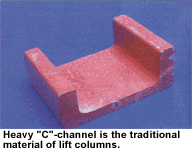
There are three or four ways to build a column. The first and oldest way uses a very heavy “C” channel. This rigid design is very similar in construction to a fork lift. While most above-gound lifts start out using this gauge, most companies have switched to lighter materials in order to lower costs in a price-competitive market. The next common design is a folded sheet metal column. The thickness of the sheet metal and the number bends in each column determine the column’s strength. While this design works well enough, when relatively thin steel is used, it flexes a lot under a heavy load. The less flexing a lift does, the more forgiving it will be when your technicians are pushing and pulling against a transmission or a stubborn ball joint. Other designs include “I” beam columns, and a few lifts use a folded sheet metal box with square tubing welded inside for added strength. Of the four designs, the “C” channel is the most rugged, and, if the fork lift industry is any indicator, it’s the one likely to be around the longest.

Carriages

Carriages are the parts that move up and down inside the column. Welded from thick plates or folded sheet metal, the carriage design has two points worth asking about: What guides the carriage within the column, and how is the arm held in place?

Take note of the safety system. Is the safety in the column or part of the carriage? In most cases where the safeties are part of the column, they don’t function below tow or three feet. To be safe under a lift while it’s at or near the ground (while servicing brakes or struts, for example), be sure to ask if the safeties are active at all heights.
Carriage Guides

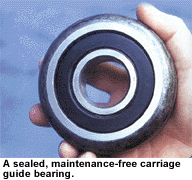
As the lift goes up, carriage guides go between the steel of the carriage and the steel of the column to keep them from wearing each other out. A bearing, a roller, or a plastic slide are used in the different designs. The bearing is a sealed, hardened, tight-fitting part, which requires no maintenance. The bearings fit snugly and the carriage cannot tilt in the column. The best bearings are packed with grease and double sealed to keep out the debris found in most automotive shops.

The next best thing to a bearing is a roller. While the roller is stronger than a plastic slide and fits tighter to eliminate slop, it usually incorporates some type of sacrificial material to bear the brunt of the wear. A roller in a heavy-duty application like a lift will wear out the bronze bushing on which it rolls. Left unserviced, the problem can result in a chain or cable failure. Any lift with a pulley or a roller can experience this kind of wear and most will need replacement during their service life.

Finally, there are plastic slides. These slides are the least expensive way to build the carriage but are the most demanding in terms of maintenance. The plastic material used in these slides, UHMW, is very hard and can withstand a great deal of pressure. But since these slides do not actually turn as the carriage rises, they require more play in the carriage to prevent binding. This play may make the carriage tilt unevenly as it rises. Also, they require regular attention. While slide block lifts are always cheaper than bearing lifts, most manufacturers require that the columns be degreased, cleaned, and re-lubricated monthly. In reality, most shop owners are too busy to do this regularly and the slides wear out prematurely. If this happens, be prepared to pay a hefty service bill since the lift will need to be completely torn down to remove the carriages and replace the sliders. Be aware that some companies call their sliders “bearings.” Ask what they mean to be sure.

Arms

For long-term non-dropping performance, look for a lift with arms that are supported from underneath. The strongest carriage designs use a steel plate on the top and the bottom that sandwiches the lifting arm. Alternatively, some companies support their lifting arms by drilling a hole through two plates and pinning the arm to the carriage. While this technique does work and saves money, it places all of the vehicle’s weight against the pin. Over time, these pins and the holes they go through become worn. As a result of these egg-shaped holes, the arms drag on the floor, and you’ll eventually need to replace the arms, pins, and carriages.
Chains, Cables or Nothing

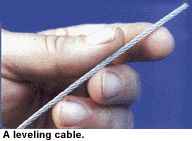
Ask what keeps the lift level. What pushes (or pulls) the car up? The majority of lists use a piston to do the heavy lifting. But what else do they use? Are they lifting with chains or cables? Are they maintaining level by these devices? With pulleys?

The answers to these questions will tell you a lot about how high your maintenance costs will be later on. Lifting and leveling are two different things. Ask how big the piston is (some companies use only one piston, but most use two). Some lift companies use a piston as small as 1-1/8 in., while others have pistons 3-5/8 in diameter. The greater the piston’s diameter, the easier the work will be and the longer the pump/seals/hoses will last.
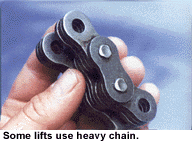
Chain, as opposed to cable, is likely to last much longer on a lift. Even when cables are used for leveling, they still bear a heavy load when a safety engages or if the vehicle is loaded off-center. Ask to look at an installation manual and you will likely see a monthly maintenance requirement. Cables in lifts are vulnerable to road salt, rust, and grit. Like clutch cables, they eventually run out of adjustment and need replacement. The bigger issue however, is the cost of downtime. A set of cables may only cost you $300-$400, but what will it cost if one breaks while the car is still on the lift? What do you think the chances are that it will break when the lift is empty? And, finally, what if it takes two days to air-freight the parts? How much repair work will you lose while waiting?

Cleary, when it comes to lifts, the lower the price, the more likely you are to experience higher maintenance expenses. Chains are rarley going to need to be replaced but cables probably will. If you buy a lift with cables, be committed to taking good care of it.

There are a few other design questions to ask. Does the lift use hoses or stainless steel line? Are truck adaptoers standard or optional? How many sets come with each lift?

What kind of company am I dealing with?

After considering those major items, the next key to a smart lift purchase revolves around knowing who your manufacturer is.

The first and best indicator of who your supplier is and how likely it is to stand behind its product later is its commitment to safety. The newest ANSI standard for lift safety (A.N.S.I./ALCTV-98) was developed by ETL, an OSHA-recognized testing laboratory. The program, developed by participating members of the Automotive Lift Institute (ALI), requires that lift manufacturers that wish to label their products as “certified” must subject their lifts to rigorous testing and must put in place stringent quality control procedures. The ALI is responsible for such recent advances in product safety as arm restraints, chain break safeties and hydraulic blow-out valves. Look for the “ETL certified” label.

Another way to judge your manufacturer’s commitment to your success is the warranty. More than any other issue, on his one YOU HAVE TO DO YOUR HOMEWORK! For example, a company says it has a five-year warranty, but does that cover parts, labor, travel and shipping charges? Labor alone can cost $500.

For some companies, warranty work is actually a profit center. A lift manufacturer may be willing to offer a low purchase price to get you to buy, but once you become a customer, you’re locked into that company for parts. Unfortunately, sometimes those parts cost more than they should. Keep in mind that a service call to fix a leaky piston, worn rollers, or broken cables can easily run $1000.

Be a smart consumer and call the factory for warranty details because reps, tool salesmen, and distributors can sometimes be confused on this issue. Ask for a copy of the warranty in writing. In most cases, the warranty only covers defects in workmanship. Even then, it may be up to you to prove that a part was defective by shipping it cross-country at your expense. Worse still, your lift will be out of service while you wait for the replacement.

One way to be sure you’re doing business with the right company is to ask how warranty parts are sent out. Find a company that ships parts freight prepaid. Find a company that will pay for travel for a service call, or ship a swap-out cylinder so you don’t have to take a lift off-line. Remember, a cheap tool always costs more than a good one.

In buying your next lift ask the important questions. Be sure to buy the best value instead of the best price.

New lifts raise the bar

In operation since 1981, Mohawk Lifts, Amsterdam, NY, produce vehicle lift products that incorporate a combination of safety systems, design, construction and what the company says is the most inclusive warranty in the lift industry. The company’s environmentally safe above-ground service lifts offer capacities that rang from 6,000 to 320,000 pounds. Mohawk customers include thousands of public and private bus and motorcoach fleets, and repair and maintenance facilities. According to Mohawk, the company is one of the few lift manufacturers whose products have passed rigid third party compliance testing to ANSI/ALI ALCTV-1998.

Mohawk’s hydraulically equalized two post lifts such as models LMF-12 and TP-16 allow the overhead hydraulic lines to be set at any height or routed in-floor for full lifting of all tall trucks and vans. All Mohawk two post lifts feature all position mechanical safety locks in both columns, infinite position hydraulic safeties and truck adaptors as standard equipment.

Mohawk columns are constructed of 3/4-inch thick C-shaped forklift mast sections. All carriages ride on 16 double-sealed self-lubricating steel ball bearing rollers as opposed to  plastic slide blocks, which Mohawk says give the lift a longer life cycle.

Model LMF-12 and TP-16 mid-rise lifts
The Mohawk Lifts Model LMF-12 clear-floor above-ground lift is capable of raising light and medium duty vehicles up to 12,000 lbs. This electric and hydraulic lift features all position mechanical and hydraulic safety mechanisms while allowing total drive through with height adjustable overhead hydraulic lines with Mohawk-patented hydraulic equalization.

The LMF-12 is a twin-cylinder direct-drive design that eliminates the need for chains or cables, and is ideal for medium duty and utility vehicles.

Mohawk Model TP-16 also is a clear floor above ground lift capable of raising medium duty vehicles up to 15,000 lbs. and features automatic locking arms. Mohawk says it makes underground hydraulic line installation available as an option.

Model MP-18 and MP-24 mobile column lifts
With a per column capacity rating of 12,000 to 40,000 lbs. the MP series lift range hefts from 24,000 to 320,000 lbs. Mohawk says one person can easily position the lifts and that models in the MP series turn any flat area into a productive work bay.

The company says the electric-hydraulic systems assure steady and smooth lifting of all vehicles without the use of acme or mechanical screw systems that wear and must be replaced. Each column can operate independently or control all four, six or eight posts in use. Safety systems include electric and hydraulic synchronization systems, pressure compensated flow-control, velocity-fuse valving and all-position mechanical safety locks.

Prudent Purchasing

Here’s what you need to consider before signing a cooperative contract.

Since 1990, the number of national purchasing cooperatives has increased dramatically, expanding the range of goods and services beyond what’s available through state contracts. A public works department can get virtually everything it needs, from copy machine paper and telecommunications systems to road salt, dump trucks, and vehicle lifts to construction equipment.

Click here to download the complete PDF article.

Cooperative Purchasing Makes Sense – and Saves Cents

By: Cooperative Purchasing Newsletter

When calculating the Total Cost of Procurement (TCP), it is not enough to look at the price of the product or service alone. TCP is composed of the time, effort, and resources that go into the final delivery of an item, including:

  • Specification research
  • Vendor interviews
  • Creation of bid & RFP documents
  • Advertisement of procurements
  • Pre-bid conferences
  • Bid openings
  • Bid & RFP evaluations
  • Coordination of evaluation committees
  • Creation of award recommendations
  • Action taken by governing body
  • Protection against legal challenges
  • Establishment of contract documents
  • Issuance and/or negotiation of contracts
  • Administration of contracts

Consider the hard dollar costs of such activities as advertising as well as the soft dollar costs associated with time spent by purchasing and legal staff in the procurement process. Once all these factors are added, the TCP can range from under $1,000 for a simple commodity purchase to many thousands of dollars for more complex RFPs. The time involved in making an award fora more complicated procurement can easily exceed 12 months.

Cooperative purchasing makes this process much more efficient by relying on the procurement steps that HGACBuy has already completed. In most cases, purchasing through HGACBuy involves working directly with a contractor, receiving a quote, and issuing a purchase order. By using HGACBuy, you are working directly with another unit of local government since HGACBuy isa political subdivision. By leveraging thousands of local governments nationwide, the savings on the product or service adds up as well. So to meet the procurement needs of your jurisdiction,cooperative purchasing through HGACBuy not only makes sense; it saves cents, too!

Why Cooperative Procurement Can Pay Off For Public Fleets

By: Chad Simon – Government Fleet

Cooperative buying programs, such as HGACBuy, enable public sector fleets to save on vehicle and equipment purchases.

AT A GLANCE
Cooperative purchasing programs, such as HGACBuy, can provide the following services to public sector fleets for competitive bids and proposals:

  • Conduct research and surveys.
  • Develop specifications for each product or service.
  • Solicit vendor participation and issue specifications documents.
  • Conduct pre-bid and pre-proposal conferences.
  • Open bid and proposal responses before evaluation.
  • Issue vendor contracts awarded by the program’s board of directors and certify contract validity.

Public sector fleets and government agencies of all levels throughout the U.S.are increasingly utilizing cooperative procurement, or consortium, tactics to purchase vehicles and equipment at the lowest possible price.

Designed to promote activity among local governments, cooperative procurement improves efficiency by granting inter-governmental contracting authority at the local level, including contracts between all political subdivisions and state agencies.

H-GACBuy Cooperative Purchasing Program

Open public procurement allows a government entity to purchase items while demonstrating fiscal responsibility with taxpayer money, offers vendors an opportunity to compete, and enables governments to obtain the best overall price, according to Bob Wooten, program manager, cooperative purchasing, Houston-Galveston Area Council.(H-GAC).

In 1971, the cooperative procurement strategy was introduced to the state of Texas with the passing ofthe Interlocal Cooperation statute, which allows acity, county, state,or other governmententity within the state of Texas to legally purchase items of significant value through a competitive bid process.

“It can take 3-9 months to complete a procurement process. Soft costs include time involved in research, negotiating a contract, and attorney and stafffees, ”said Wooten.

However, through HGACBuy — H-GAC’s cooperative purchasing program used exclusively by governmental entities — any government agency can procure items, including cars, fire trucks, and fleet maintenance equipment. After the competitive bid process, H-GAC issues a two-year contract to the lowest responsible bidder. Minimizing cost and time, the contract allows government entities that meet legal requirements to purchase equipment, according to Wooten.

“Public fleets can obtain better pricing through the contract, leveraging the power of our membership to get the best possible pricing. The competitionand size of membership usually provide better pricing than fleets would get on their own,”said Wooten.

Services Offered

As a designated purchasing agent on behalf of participating government fleets, H-GAC performs the following services for competitive bids and proposals:

  • Conducts research and surveys.
  • Develops specifications for each product or service.
  • Solicits vendor participation and is-sues specifications documents.
  • Conducts pre-bid and pre-proposal conferences.
  • Opens bid and proposal responses before evaluation.
  • Issues vendor contracts awarded by the H-GAC board of directors and certifies contract validity.

Let the Bidding Begin

The bid process starts with a draft bid solicitation sent to all potential bidders. After a pre-bid conference, the final bid document is created and, after evaluation, the H-GAC board of directors awards the winning vendor a contract to provide goods and services to government members.

“For example, if a city wanted to buy 10 police cars, they would look on our Web site (www.hgacbuy.org) to see which vendors we have under contract for the type of police car they want. The member would call the contractor directly to work up a quote for them based on HGACBuy’s contract pricing. The member would then purchase directly from the vendor who delivers the product or service to the member,”said Wooten.

A contracted list of aftermarket options is also available to vendors, including lightbars, customized paint, etc.

In 2005, $220 million in products and services were bought through HGACBuy and about $240 million in 2006. The program has 300 vendors under contract and more than 1,700 government agency members spread across 27 U.S. states, growing by about 125 agencies each year, according to Wooten.

H-GAC is just one government-to-government co-op for procuring goods. The Mid America Regional Council (MARC) serves the Kansas City regional market in the same way H-GAC serves nationally.

Using Another State’s Contract

H-GAC’s contract terms and conditions mandate the guaranteed lowest prices on vehicles and equipment, according to Steve Perlstein, government sales manager for Mohawk Lifts, an HGACBuy vendor and contract holder for garage lifts with MAS contracts serving 19 states, HGAC, MARC, and GSA.

For agencies that don’t have a contract, state procurement statutes (purchasing laws) allow an agency within the non-contracted state to use another state’s contract.

“For example, there are no lift companies that have a contract with the state of Colorado; however, the town of Parker, Colo., wanted to purchase a Mohawk lift and used another state’s contract, which offered four lift brands, as a contracting vehicle, ”said Perlstein.

WSCA Stipulates Lowest Pricing

The Western States Contracting Alliance (WSCA), a trade organization comprising mostly Western states, also has a contract for garage lifts and related equipment; however, any state can join this contract. Since each offer stipulates the prices are the lowest to any government agency, if a price decreases for the private sector, or the product’s list price decreases, so does the government price, according to Perlstein.

The WSCA was a competitively bid contract, sent to all members of the Automotive Lift Institute (ALI).

For a WSCA state to become an active participant in the multi-state WSCA contract, the state signs a participation agreement attached to the WSCA contract.

Not all WSCA member states have joined the WSCA procurement, while some non-WSCA member states, such as Missouri, have joined. Participation in a WSCA contract is a state-by-state decision. However, if a state elects to participate in a WSCA contract, usage is voluntary among its local government agencies, according to Perlstein.

Read entire article (PDF)

Lift training and maintenance urged to prevent damage and injuries

By: Kevin Loewen – Parts & People

Cortland, N.Y.—What goes up must come down.  And when what has gone up is a vehicle weighing thousands of pounds, making sure that the descent is controlled can be a matter of life and death, said Bob O’Gorman, President of the Automotive Lift Institute (ALI).

O’Gorman said the mission of ALI, founded in 1945, is “promoting the safe design, construction, installation, and use of automotive lift products.”  In this role, the association has formed a lift certification program, a lifting guide safety manual and video, a lifting-points manual, and other tools to help the automotive service industry safely operate the hundreds of thousands of lifts that are used daily by the industry.

The association is made up of 19 member companies and one nonmember certification program participant, O’Gorman said.  The companies, all North American, engineer, design, distribute, and service more than 80 percent of the lift equipment sold in North America.

The number of lifts used in the automotive industry has exploded in the past 20 years, O’Gorman said, and while the lift industry has a strong safety record, accidents do happen and can have catastrophic results both for the service technician and for the business that owns it.

“I’ve never met someone who wants to be injured or a responsible employer who accepts injuries as a cost of doing business,”O’Gorman said.

“If safety is a core value, I think every injury is preventable.”

The first step in ensuring safety is for shops to purchase lifts that have been certified to the American National Standards Institute ANSI/ALI ALCTV, O’Gorman said. This is already required under local building codes in the 47 states that have adopted the International Building Code, he said.

Even if a shop is not required by local code to have a certified lift, O’Gorman said it is important because it confirms that the lift has been tested to perform up to its listed specifications, for instance the amount of weight it is able to lift.

“There is a statement that has been around the lift industry for many years that I just hate,” he said.  “‘Save a buck on hope and luck.’ In my opinion, that’s what shops that buy noncertified lifts are doing. I believe they are taking a tremendous risk.”

The next step, whether a business has existing lifts or has just installed new lifts, is to establish a planned service regimen, O’Gorman said.  The American National Standards Institute ANSI/ALI ALOIM (Automotive Lift Operation Inspection and Maintenance) recommends that businesses follow the lift manufacturer’s recommendations for service and inspection or, in the absence of manufacturer information, follow the standard. he said.

O’Gorman said OSHA does not have its own regulations on lifts but instead uses ALI’s standards and can, therefore, under its General Duty Clause, cite shops for not performing planned maintenance. He said that in the case of a workplace accident or complaint, OSHA would inspect a shop’s equipment and records, and can also do that as part of a regular inspection.

While it is possible to handle inspections and service in house, O’Gorman said he suggests “leaving it to the pros,” either the manufacturer’s personnel or their distributors staff. “A shop owner needs to consider the liability factors and risk management factors of servicing and maintaining lifts in house,” he said.

ALI has also developed several products to help shop owners ensure that employees understand how to safely use a lift, O’Gorman said. In October, the association introduced a 24-minute lift safety DVD hosted by NASCAR legends Richard and Kyle Petty, he said. The DVD kit, in addition to the training video, contains the association’s safety manual and a written test that managers can have employees take to ensure they understand the safety information.

O’Gorman said the kit can be obtained through ALI for $79 or maybe available at a discount through lift manufacturers or other trade associations, such as the Tire Industry Association (TIA).

In recent years, ALI has developed a Strategic Safety Alliance program to help disseminate its safety materials. TIA and a several state autodealer associations have joined the program as have industry participants such as Bridgestone/Firestone.  It has helped the issue of automotive lift safety training reach thousands of people, O’Gorman said.

In addition to the video, the association also offers the industry recognized “Vehicle Lifting Points Quick Reference Guide”, O’Gorman said. The guide includes manufacturers’ suggested lifting points, he said. Lifting at other points on the vehicle can result in vehicle damage, injury, or lift failure, he said. O’Gorman said ALI is happy to help shops interested in lift safety and encourages them to contact the association at 607-756-7775 or by visiting its Web site at www.autolift.org.

Read entire article (PDF)

Getting the Most Out of Your Lifts

By: Tim Fritz

Lifts play an important role in in the day-to-day operations of any automotive service facility. Some may even argue that a lift is a shop’s most valuable employee. After all, lifts never call in sick or go on vacation. However, one of the worst things a shop owner can do is fall into the trap of taking lifts for granted.

Read entire article (PDF)

University of Michigan-Dearborn Public Safety & Environmental Health

By: Laura L. Drabczyk – Public Safety & Environmental Health

“The Mohawk Turf Package has made a world of difference.  It is easier to service lawn maintenance equipment since you can see better, the equipment is more secure on the lift than the floor jack, but most importantly there is no more lying on the floor in awkward positions for the back and rest of the body.”

Read entire article (PDF)

Mohawks Speedlane gets Motor Magazines annual TOP 20 award

Mohawks SPEEDLANE adaptor allows two post swing arm lifts to quickly convert to a two post drive on pad lift which leaves the wheels hanging free for tire and brake service.

Motor Magazines annual TOP 20 award is given to 20 tool and equipment manufacturers who have invented a shop productivity tool that allows greater flexibility and time savings in performing vehicle maintenance services.

Mohawks previous TOP 20 award (2004) was the safety weight gauge for two post lifs, which has since expaned and is offered with any of 11 different Mohawk Lifts, including Mohawks MP series of Mobile Column lift.