By: Steve Perlstein
 Everyone is busy managing their business. Sometimes your business can manage you, which is never good for your time management, getting everything done you need to do and seeing all the prospects you need to see. All can show up on your bottom line and profits.
As a PD reader, your most valuable asset is your time. No matter how you view your business or the number of hours you work weekly, there is still just a maximum of about 50 hours that you can visit customers, build customer goodwill, sell product, maintain and build supplier relationships. Everything must happen in these 50 hours, and you need to spend them profitably.
Maximizing time
As a 20-year-old, I sold equipment. On occasion we would travel to the industry trade shows in Las Vegas, Chicago or Atlantic City. I would walk the aisles amazed at all the new tool and equipment product offerings from all the manufacturers and return with bags of product information.
My boss, Bruce, never returned with as much info at the end of the day. At these trade shows, Bruce was spending his time where he could make the most money. I wasn’t as seasoned as he was. A typical conversation at a manufacturer’s exhibit was something like:
“Hi. How does your company go to market?” Bruce asked.
Often the exhibitor wouldn’t “hear” the question, and start talking about the new product, its features or how it worked.
Bruce would politely listen for a moment and again ask, “OK, but how do you go to market?”
The exhibitor would then hear and understand Bruce’s question. Depending on the answer, Bruce would decide if we would spend some time in the booth and learn more about the manufacturer’s products, or if we made a hasty departure.
The answers from exhibitors generally fell into a few categories.
1. The manufacturer said that they had a rep network in place and that the rep would contact Bruce. Depending on what rep agency, Bruce might depart right away or he’d await a call when he returned. For most manufacturers, traditional reps set up many resellers in a sales territory.
2. A manufacturer might describe how they established limited or very select distribution in a geographic sales area.
3. Another manufacturer might respond that they established exclusive distribution in a sales geography. A response like this is why Bruce always asked how a company went to market long before he asked how the product worked.
Answer three relates to the maximum 50 selling hours you have every week. As a distributor, Bruce understood his profit margins, cost of fuel, service and costs of a product, as well as warehousing and inventory costs. If Bruce couldn’t make his acceptable profit reselling a manufacturer’s product, Bruce would find another product to occupy his sales opportunity hours.
For example, a can of cola will sell in some stores for 80 cents and others for $1.25. That there are 10 stores in town selling this same can of cola somewhat limits a reseller’s price. Bruce never wanted to be a “me-too” distributor. He never wanted to buy, stock, service and resell any product that didn’t give him an adequate return on his financial investments in inventory or, more importantly, on his investment in time. Bruce wanted products that offered “limited, selective, or protected sales areas.”
Another of Bruce’s business philosophies was to become a specialist. In all of life’s circumstances, there are specialists and there are generalists. By specializing, Bruce became the go-to guy to the garages in his territory. As a specialist, Bruce knew his own products inside-out, but, more importantly, he knew his competitors’ products, often better than his competitor who usually was a generalist.
Develop, manage goals
In managing his business (vs. having the business manage him), Bruce had clear and established short-term, medium-range and long-term goals. And by sticking with his established goals, Bruce knew he had to:
1. Continue to build and maintain relationships with his customer base.
2. Expand that customer base by mandating that he and all of his salespeople made several new cold calls weekly.
3. Serve his customers with regular, live face-to-face visits.
Telemarketing, e-mails and mailers all have their place in our busy world, but do people build a loyal and long-term customer base with e-mails? No, all are a supplement and will never replace a personal visit from you on whatever your business considers a regular visit. Only by being in a customer’s shop can you notice the little things that can build and strengthen a relationship (a picture of a new baby, or grandchild; a new lift). All give you the opportunity to interact with your customer, something that a mailer or e-mail will never do.
Bruce would step back and reevaluate his business a few times a year. He would review profitability of each line he carried. If a line wasn’t contributing to his overall company profits, then dropping that line was the next step. I recall two sides of the same conversation Bruce had with one of his factories. Bruce looked at his time investment and decided that he was going to give up a certain brand of products. The factory person told Bruce he was crazy and couldn’t give up a line with hundreds of thousands in sales. Both were right, as each side saw the situation through their own experiences.
Your next time considering a new line, ask:
1. How many others in your area sell it?
2. Does the factory compensate you if a national account in your area buys one?
3. What’s the opportunity for profits if you invest your time?
4. In asking these questions, dive deep for product knowledge. Visit the factory, take the distributor training classes to learn everything you can about the product, the company and to meet the people you’ll be working with.
Invest your time wisely or it can vanish, and you’ll find that your business runs you vs. you running your business.
Steve Perlstein is the sales manager for Mohawk Lifts.
Click for the complete PDF article featured in www.ProfessionalDistributorMagazine.com









 Look at the North Pole, specifically the white dot 400 miles south of center. This is the “Alert” military base and the furthest northern point of year round human habitation. Our estimate is the Alert base is over 4000 miles north of the Mohawk factory (red dot). Well they just purchased Mohawk mobile column lifts for their vehicle maintenance needs.
 Ron Veresko of Mohawk Lifts touring the NASCAR Hall Of Fame with King Richard Petty. The event was the Petty Family Foundation Charity Auction and Dinner. Ron was one of 4 member companies that were in attendance representing the Automotive Lift Institute.
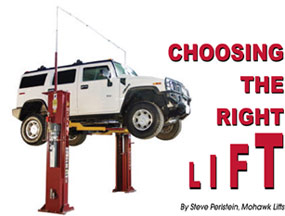 With all the lift choices available to today’s shop owners, if we wrote about every type, size and style available, it would require an entire issue of Auto International.. The choice of two post, four post, parallelogram, scissors, in-ground and mobile lifts, can leave lift buyers wondering which is best. AI decided to write about the two post, above ground lift in the 10,000 to 16,000 lb capacity for many: reasons #1 They’re the most popular lift amongst AI readers. #2 This type lift represents over 2/3rds, of the lifts being sold, #3 While some shops still use inground lifts there has been a significant trend toward replacing these in-grounds with surface mounted lifts. #4 Finally, we chose the two post lift because, they take up less shop space, leave the wheels hanging free and give shops the most undercar access. This story will explain the details and differences of different two post lifts – The most popular lifts in the world.
 By: Josh Cable
 by: statepolitics.lohudblogs.com
 Cooperative procurement allows government agencies to purchase equipment and vehicles under another government entity’s contract.
 Andy Cohen producer of THE ROAD TO SEMA uses Mohawk lifts in the fabrication & customization of all vehicles in his shop.
 By: Steve Perlstein